How Does Operational Planning Help Businesses Build Long-Term Success?
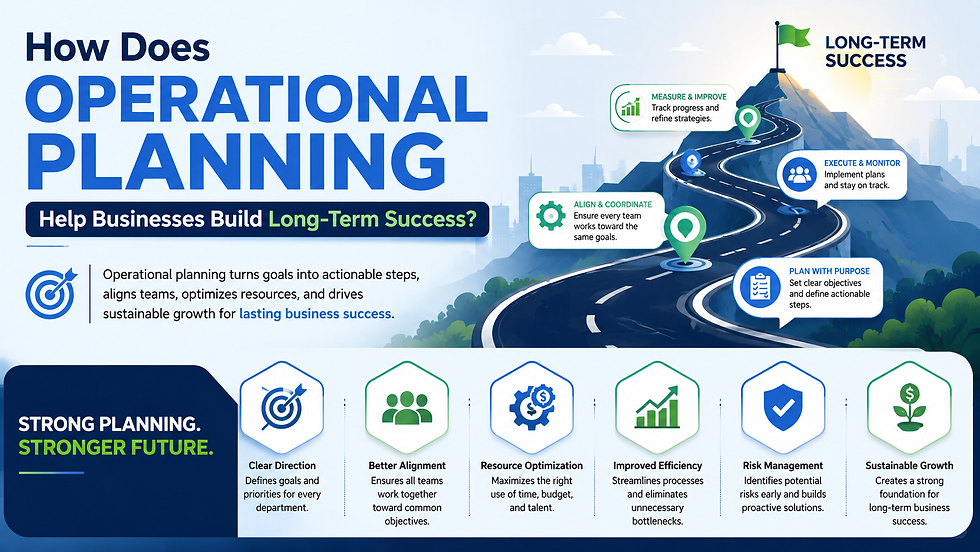
Every successful organization begins with a vision, but lasting growth depends on turning that vision into practical actions. Operational Planning provides the structure needed to transform strategic goals into measurable daily activities that keep teams aligned and focused. While strategic thinking provides direction, execution determines whether objectives become measurable achievements. Businesses that organize daily activities around clear priorities often adapt more effectively to changing market conditions while maintaining consistency in performance.
Clear execution frameworks allow every department to understand its responsibilities without confusion. When expectations are defined from the beginning, teams spend less time solving avoidable problems and more time creating value. Structured workflows also improve communication because everyone understands how individual contributions support broader business objectives.
Modern organizations operate in competitive environments where efficiency, flexibility, and accountability are equally important. Companies that create repeatable systems for assigning responsibilities, monitoring progress, and evaluating results often experience stronger collaboration and better resource utilization. Rather than reacting to challenges as they arise, successful organizations prepare processes that reduce uncertainty and encourage informed decision-making.
Creating Clear Direction Across Every Department
Business success depends on alignment. Every department contributes differently, yet each team must work toward shared organizational objectives. Without a common direction, duplicated efforts and conflicting priorities can slow progress.
Establishing clear responsibilities allows employees to understand expectations from the beginning of every project. Marketing, finance, operations, customer support, and leadership all benefit when objectives remain connected through consistent communication.
Defined workflows also simplify collaboration between departments. Instead of waiting for approvals or searching for information, employees can move confidently through established processes. When supported by workforce analytics, organizations gain deeper visibility into team performance, resource utilization, and operational efficiency. This creates smoother project execution while reducing delays that impact productivity and customer satisfaction.
Organizations with transparent structures often identify improvement opportunities faster because performance becomes easier to evaluate across every function.
Improving Resource Allocation With Better Planning

Every organization operates with limited resources, making thoughtful allocation essential for sustainable growth. Financial investments, employee time, technology, and operational capacity all require careful management to maximize value.
When businesses prioritize activities according to organizational goals, unnecessary spending becomes easier to identify. Teams focus on initiatives that generate measurable outcomes instead of distributing resources across too many competing priorities.
Effective resource management also supports workforce efficiency. Managers can balance workloads more fairly, prevent burnout, and ensure critical projects receive adequate attention throughout their lifecycle.
As priorities evolve, organizations with structured planning processes can adjust budgets and staffing more confidently while maintaining overall business stability.
Strengthening Accountability and Performance Measurement
Consistent improvement depends on understanding what works and what requires adjustment. Businesses benefit from establishing measurable objectives that provide meaningful insights into progress over time.
Performance tracking encourages accountability because employees recognize how their individual responsibilities contribute to organizational success. Clear expectations also simplify performance discussions by focusing conversations on measurable outcomes rather than assumptions.
Regular reviews provide opportunities to celebrate achievements while identifying obstacles before they become larger operational challenges. Continuous monitoring allows leadership to make timely adjustments instead of waiting until projects fall behind schedule.
Organizations that embrace ongoing evaluation often create cultures focused on learning, collaboration, and continuous improvement rather than short-term problem solving.
Building Flexibility for Future Growth
Business environments constantly evolve due to technological innovation, customer expectations, economic changes, and industry competition. Organizations prepared for change generally respond more effectively than those relying on rigid processes.
Flexible execution frameworks allow businesses to modify priorities without disrupting core operations. Teams become more confident in adapting to new opportunities because responsibilities and communication channels remain clearly defined.
Scalable systems also support long-term expansion. Whether entering new markets, introducing additional services, or growing workforce capacity, organizations with structured processes transition more smoothly through periods of change. Measuring Team Performance becomes more effective when standardized processes provide clear benchmarks, helping leaders identify strengths, address performance gaps, and align teams with organizational objectives. Adaptability does not require abandoning established practices. Instead, it involves continuously refining systems to support evolving business needs while maintaining operational consistency and using performance insights to drive continuous improvement.
Encouraging Collaboration Through Shared Objectives

Collaboration becomes significantly stronger when employees understand how their work connects with organizational outcomes. Shared objectives encourage departments to communicate openly, exchange ideas, and solve problems collectively rather than work independently.
Cross-functional cooperation reduces misunderstandings while accelerating project completion. Employees gain greater appreciation for different perspectives, leading to more innovative solutions and stronger decision-making across the organization.
Leadership also benefits from collaborative cultures because information flows more freely throughout the business. Challenges surface earlier, opportunities become easier to identify, and strategic initiatives receive stronger organizational support.
Businesses that foster teamwork through clearly communicated objectives often develop resilient workplace cultures capable of sustaining growth over the long term.
Conclusion
Sustainable growth depends on transforming ideas into consistent action, and operational planning provides the structure that makes this possible. By aligning teams, managing resources effectively, strengthening accountability, encouraging collaboration, and remaining adaptable, organizations build reliable foundations for long-term success. Businesses that consistently refine their execution processes position themselves to achieve stronger performance, respond confidently to change, and create lasting value for employees, customers, and stakeholders alike.
FAQs
1. Why is execution important for business growth?
Execution transforms business goals into measurable actions, helping organizations achieve consistent results while improving efficiency.
2. How can businesses improve team alignment?
Organizations can improve alignment by communicating shared objectives, defining responsibilities, and maintaining transparent workflows.
3. What role does resource management play in business success?
Effective resource management ensures budgets, people, and technology are used efficiently to support organizational priorities.
4. Why should organizations measure performance regularly?
Regular performance evaluation helps identify strengths, address challenges early, and support continuous improvement.


Comments