Why Do Companies Use Work Tracking Software For Better Team Accountability?

Why do some companies consistently deliver projects on time while others struggle with missed deadlines and unclear responsibilities? In most cases, the difference comes down to operational visibility. Businesses today need structured systems that help managers understand who is doing what, when tasks are completed, and where delays occur.
That is exactly why many organizations now rely on work tracking software to improve team accountability and operational efficiency. These platforms centralize workflows, simplify reporting, and reduce communication gaps across departments. From startups managing remote teams to enterprises handling multiple projects simultaneously, digital tracking systems help employees stay aligned with business goals while creating measurable performance standards.
What Makes Team Accountability Difficult in Modern Workplaces?
Workplaces have become significantly more complex over the last decade. Hybrid schedules, remote collaboration, and cross-functional teams create communication challenges that traditional management methods cannot solve effectively.
In my experience working with growing operations teams, the biggest accountability issues usually come from three problems:
Unclear ownership of tasks
Lack of deadline visibility
Inconsistent reporting systems
When employees rely only on email threads or verbal instructions, priorities quickly become disorganized. Managers spend unnecessary time following up instead of focusing on strategic work.
Modern workflow platforms solve this by creating transparent systems where every task, update, and completion status is visible in real time.
Why Visibility Improves Performance?
Research from organizational behavior studies consistently shows that employees perform better when expectations are clearly documented. Visibility reduces confusion, minimizes duplicate effort, and helps teams collaborate more efficiently across departments. Companies that implement structured systems and modern productivity tools often experience improved accountability because managers can monitor progress, identify bottlenecks, and provide timely support when needed.
Companies using structured tracking systems often experience:
Faster project completion
Improved deadline accuracy
Better interdepartmental communication
Reduced operational bottlenecks
Higher employee accountability
The psychological effect is important as well. Teams become more responsible when responsibilities are measurable, and progress can be monitored objectively.
How Businesses Use Structured Tracking Systems Daily?

Many people assume these platforms are useful only for IT companies or large enterprises. In reality, almost every industry now benefits from digital workflow oversight.
Marketing agencies use them to monitor campaign approvals. Construction firms manage vendor timelines. Healthcare administrators track operational compliance tasks. Even small retail businesses use digital dashboards to organize scheduling and inventory coordination.
One manufacturing client I worked with reduced project delays by nearly 28% within six months after implementing automated task assignments and progress notifications. The improvement did not come from working longer hours. It came from reducing confusion and improving accountability structures.
The second major advantage involves data-driven management. Instead of relying on assumptions, leaders can identify patterns such as:
Repeated workflow delays
Uneven employee workload distribution
Resource shortages
Inefficient approval chains
This creates smarter operational decisions over time.
Why Employee Transparency Matters More Than Micromanagement?
Many companies mistakenly believe accountability means constant supervision. In practice, excessive oversight usually reduces morale and slows productivity.
Effective accountability comes from clarity rather than pressure.
The best managers focus on:
Setting measurable goals
Creating realistic timelines
Defining ownership clearly
Monitoring outcomes consistently
This is where work tracking software becomes especially valuable. Employees can update progress independently while managers maintain visibility without interrupting workflows repeatedly.
Quick Tip for Better Adoption
Companies achieve better adoption rates when they introduce tracking systems gradually instead of forcing sudden operational changes. Start with one department, gather feedback, and optimize workflows before expanding company-wide. This approach reduces employee resistance, improves long-term usability, and allows businesses to align processes with operational goals more effectively. Many organizations also integrate field service management solutions during expansion phases to improve coordination between office teams and remote staff while maintaining consistent accountability standards.
What Features Actually Improve Operational Accountability?
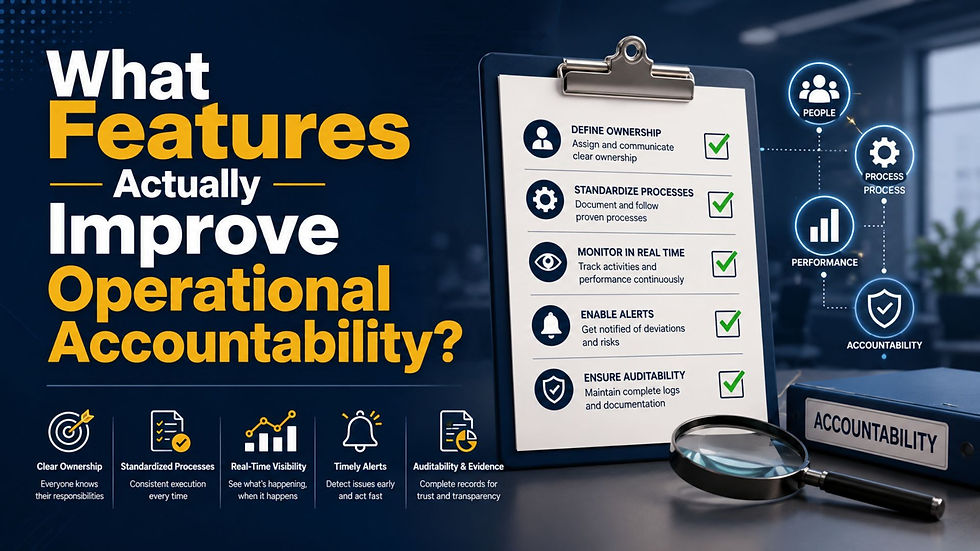
Not every platform delivers the same results. Businesses should focus on features that directly support transparency and workflow consistency.
The most effective systems typically include:
Task assignment automation
Real-time progress dashboards
Deadline notifications
Team activity logs
Performance reporting
Workflow prioritization
Mobile accessibility
However, implementation matters just as much as software selection. Poorly configured systems often create unnecessary complexity instead of efficiency.
Experienced operations managers usually recommend keeping workflows simple during the first implementation phase.
How Digital Tracking Supports Remote and Hybrid Teams?
Remote work has permanently changed how organizations manage accountability. Managers can no longer depend on physical visibility to evaluate progress.
Instead, performance must be measured through completed deliverables, response timelines, and workflow consistency.
This shift explains why many companies increasingly invest in work time tracking software to support distributed teams. These systems help businesses monitor productivity patterns, optimize scheduling, and maintain transparency without intrusive oversight.
For international teams operating across multiple time zones, centralized visibility has become essential rather than optional.
You can also watch:- HR Strategies? LEAKED. ? EmpCloud Podcast: Ep 1 Loading ?
Conclusion
Strong accountability systems are no longer limited to enterprise corporations. Businesses of every size now depend on structured operational visibility to improve efficiency, communication, and performance consistency. The companies that succeed long-term are usually the ones that build clear systems instead of relying on reactive management.
By implementing smarter processes and selecting the right work tracking software, organizations can create more transparent workflows, reduce operational confusion, and help teams perform at a consistently higher level.
FAQs
Q: What is work tracking software used for in businesses?
A: Work tracking software helps companies monitor tasks, deadlines, employee responsibilities, and project progress. It improves workflow visibility, reduces communication gaps, and helps managers identify operational inefficiencies faster. Most businesses use it to improve accountability and maintain organized project management structures.
Q: How does work tracking software improve employee accountability?
A: These platforms create transparent task ownership and measurable deadlines. Employees can clearly see priorities, and managers can monitor progress without constant follow-ups. This reduces confusion, encourages responsibility, and improves project completion rates across teams.
Q: Is work tracking software suitable for small businesses?
A: Yes. Small businesses often benefit significantly because organized workflows reduce manual coordination and improve efficiency. Many affordable platforms now offer scalable solutions designed specifically for startups, agencies, and growing operational teams.
Q: What is the difference between project management tools and tracking systems?
A: Project management tools focus on planning and collaboration, while tracking systems emphasize visibility, accountability, reporting, and performance monitoring. Many modern platforms combine both functions into a single operational dashboard for better workflow management.
Q: How much does work tracking software typically cost?
A: Pricing varies depending on features, integrations, and user count. Entry-level plans may start around $5–$10 per user monthly, while enterprise systems can cost significantly more based on customization and reporting requirements.
Q: What common mistake do companies make when implementing tracking platforms?
A: The biggest mistake is overcomplicating workflows during implementation. Companies often add too many rules, notifications, or reporting layers initially. Simpler systems usually achieve higher employee adoption and produce better long-term accountability results.


Comments